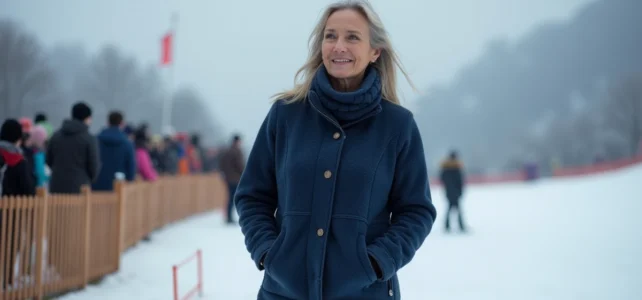
Zoé Grospiron is consistently presented as the daughter of Edgar Grospiron, Olympic champion in mogul skiing. The portraits dedicated to her almost all follow the same narrative: born in Annecy, moving to Anglet, discovering surfing, and achieving international success in longboarding.
In this well-established narrative, one figure remains in the background: her mother, Nathalie Ville-Grospiron. Her role in Zoé’s athletic development is recognized by those who know the family, but public sources on the subject remain scarce.
Further reading : Everything You Need to Know About the Compensation of a Family or Professional Tutor in France
Nathalie Ville-Grospiron and Zoé Grospiron’s Basque Roots
Most articles about Zoé pinpoint the pivotal sporting moment in Anglet in 2012, when the family moved to the Basque Coast. What is less often stated is that this territory is explicitly linked to Nathalie’s maternal roots. Anglet is not a geographical coincidence dictated solely by Edgar’s career: it is the territory of her mother.
It is in this environment that a teenager who competed in skiing in winter and surfed in summer during vacations found her preferred discipline. Longboarding became a life project, not just a seasonal hobby. As noted in the portrait of Zoé Grospiron’s mother on L’Esprit du Sport, the framework set by Nathalie influenced this direction, even if the precise details of her daily involvement remain poorly documented.
Further reading : Discover why blue roofs remain an essential tradition in China
Visibility Bias: Why the Mother of a Champion Remains in the Shadows
The media treatment of Zoé Grospiron illustrates a broader phenomenon. When a parent is themselves a public sports figure, the narrative is built around the lineage with that parent. Edgar Grospiron, Olympic medalist in 1992, provides an immediate narrative angle: the daughter of the champion forging her own path in another sliding sport.
This framing is not malicious, but it produces an erasure effect. The mother’s contribution to the athletic development disappears from the narrative, not because she is absent, but because it does not fit the expected pattern. Nathalie Ville-Grospiron has no Olympic record to cite as a hook. Her role, as structured according to the few sources that mention her, pertains to education, life choices, and family organization. Less spectacular elements, thus less reported.
This visibility bias affects the majority of high-level athletes from mixed families (one parent in the media, the other not). The available data does not allow for precise measurement of the extent of this phenomenon in French sports, but the Grospiron case is a particularly clear example.
Zoé Grospiron: What the Record Says About the Family Framework
Zoé’s competitive journey provides an indirect indication of the strength of family support. A few public milestones allow us to situate her progress:
- Third place at the French Championships in 2016, while she was still a Bachelor student at KEDGE Business School.
- Vice-European champion and eighth in the world in 2019, at an age when most athletes in her discipline are still struggling to establish themselves professionally.
- World champion in team longboarding in 2023, with Alice Lemoigne, Antoine, and Edouard Delpero, in El Salvador.
Building such a career requires a stable environment over time. International travel, managing a dual study-competition curriculum, balancing sports pressure and personal life do not rely solely on the athlete’s will. Nathalie Ville-Grospiron herself publicly mentioned, in a LinkedIn post shared after Zoé’s world title, that she reminisced about “the journey taken to reach the best global level.”
Nathalie’s LinkedIn Post: A Rare Direct Testimony
This text, published in May 2023, is one of the few documents where Nathalie speaks as the mother of a high-level athlete. She describes her gratitude in seeing Zoé “thrive in her passion and especially realize her dreams.” She also mentions that her daughter’s journey has been fraught with obstacles, without detailing them publicly.
This post is the only maternal testimony accessible in online sources. It confirms a strong emotional and logistical involvement while maintaining a degree of discretion regarding the concrete aspects of this involvement. Educational choices, financial decisions, support for competitions abroad: all topics that remain a documentary blank zone.
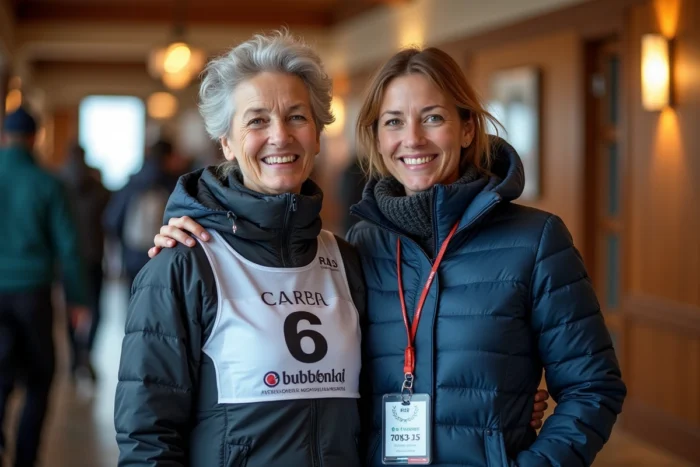
Role of Parents in High-Level Sports: Beyond the Paternal Model
The Grospiron family’s case raises a broader question about how French sports narrate its athletes. Paternal lineage serves as a convenient narrative shortcut. It provides context, legitimacy, and a media thread. In contrast, the maternal role remains confined to the implicit, unless the mother is herself a public figure.
Nathalie Ville-Grospiron is not an isolated case. In most portraits of young French athletes from sporting families, the contribution of the “non-media” parent is mentioned in a single sentence, sometimes not at all. This treatment does not reflect the reality of how a family unit organized around a sports project functions.
Field feedback varies on this point: some coaches believe that the parent who manages daily logistics has more influence on athletic longevity than the one who transmits the “competitive gene.” This hypothesis deserves to be explored beyond the single example of Zoé Grospiron.
The fact that Anglet is presented as Nathalie’s territory, and that it is precisely there that Zoé found her path, suggests that the life choices made by the mother have shaped the daughter’s athletic trajectory. A family relocation is never trivial. It produced a world champion.