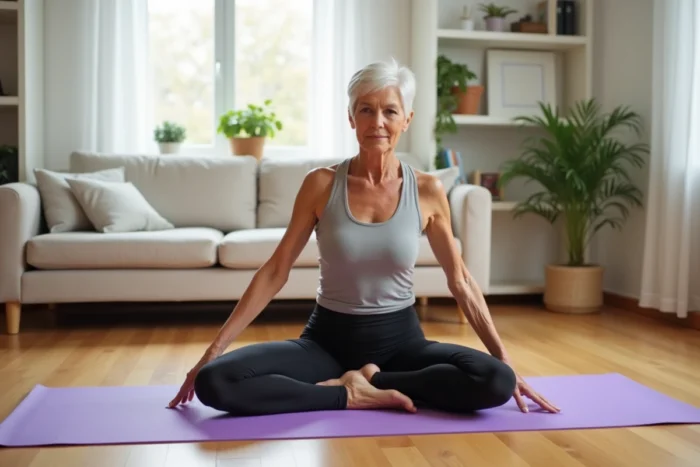
Prescribing the same gentle gym routine to an independent senior who gardens every day and to a person recovering mobility after hospitalization does not yield the same results. The choice of a senior physical activity at home becomes more relevant when it is based on the level of functional autonomy rather than the age recorded in civil status. What criteria allow for sorting exercises according to actual movement, balance, and strength capacity?
Home Routine According to Autonomy Level: Three Profiles, Three Priorities
The available content increasingly distinguishes needs based on functional age, separating priorities for independent seniors, those at risk of falling, and those recovering after an episode of fragility. The table below summarizes the work axes adapted to each profile.
| Profile | Main Objective | Types of Suitable Exercises | Recommended Session Duration |
|---|---|---|---|
| Independent (walking, stairs, shopping without assistance) | Maintaining strength and endurance | Standing muscle strengthening, squats, light lunges, dynamic walking in place | 15 to 20 minutes |
| At risk of falling (fragile balance, apprehension) | Stability and postural confidence | Assisted single-leg stance (chair), heel raises, multi-component exercises | 10 to 15 minutes |
| Recovering after fragility (hospitalization, prolonged immobilization) | Gradual recovery of mobility | Sitting exercises, gentle joint mobilizations, active breathing | 10 minutes, can be split |
The interest of this grid is to make visible a gap that age alone masks: an active 75-year-old falls into the first profile, while a 65-year-old recovering from a hip fracture falls into the third.
Choosing a senior physical activity at home suited to one’s actual situation avoids two common pitfalls: underutilizing a body still capable of progress, or causing a fall by overestimating current abilities.
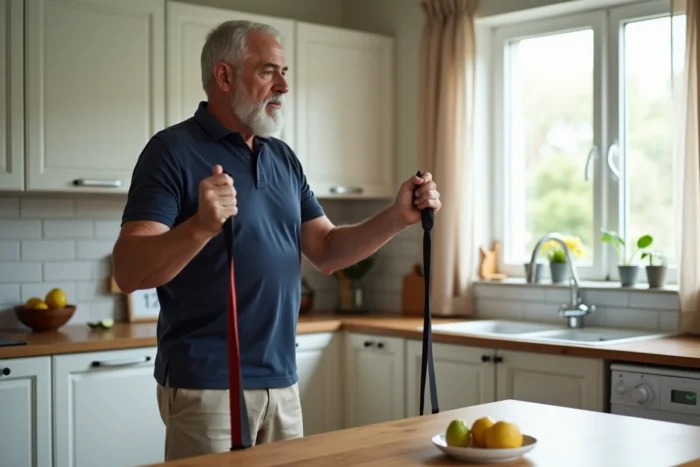
Balance Exercises and Fall Prevention at Home
Fall prevention concentrates the majority of measurable exercise benefits for seniors. Recent content places leg strength and balance work at the forefront, with precise movements.
- Chair Squat: standing in front of a chair, slowly lower down as if to sit, then rise without support. This exercise engages the quadriceps and glutes, two muscle groups directly linked to standing stability.
- Heel Raise: with feet flat, rise onto the toes and then lower back down. Hold onto a chair back for at-risk profiles. The calf stabilizes the ankle with each step.
- Assisted Single-Leg Stance: balance on one foot, one hand resting on a piece of furniture. Alternate sides. This exercise alone improves ankle and knee proprioception.
- Multi-Component Sequences: combine a lateral step, a knee raise, and a heel raise in the same sequence. This format works on coordination and postural responsiveness.
These exercises require no specific equipment. A stable chair and clear space are sufficient. For the profile recovering from fragility, the same movements can be done seated, reducing the range of motion.
Short Sessions and Consistency: The Format That Lasts
Sessions of 10 to 15 minutes practiced daily yield better results than a long weekly session. This finding appears in recent programs aimed at seniors at home. The logic is simple: a short session generates less fatigue, less post-effort joint pain, and fits into the routine without reorganizing the day.
For an independent senior, a daily 15-minute session can alternate muscle strengthening (Monday, Wednesday, Friday) and balance/flexibility (Tuesday, Thursday, Saturday). Sunday serves as active recovery: gentle walking indoors, light stretching.
For a person at risk of falling, splitting the session into two blocks of 5 to 7 minutes (morning and afternoon) reduces accumulated fatigue and maintains focus on posture. Progress is measured in weeks, not days: add a repetition or remove the support of the chair when the movement is mastered.
Combining Movement and Cognitive Stimulation
A still underutilized angle is to combine physical exercise with a cognitive task. For example, counting backward during a heel raise, or naming objects from a category (fruits, cities) during a single-leg stance. This type of sequence, sometimes called cognicise, simultaneously engages motor coordination and the brain’s executive functions.
The addition of a cognitive component doubles the interest of the exercise for seniors whose autonomy is beginning to decline. The ability to walk while talking or thinking is, in fact, a functional indicator used in geriatrics.
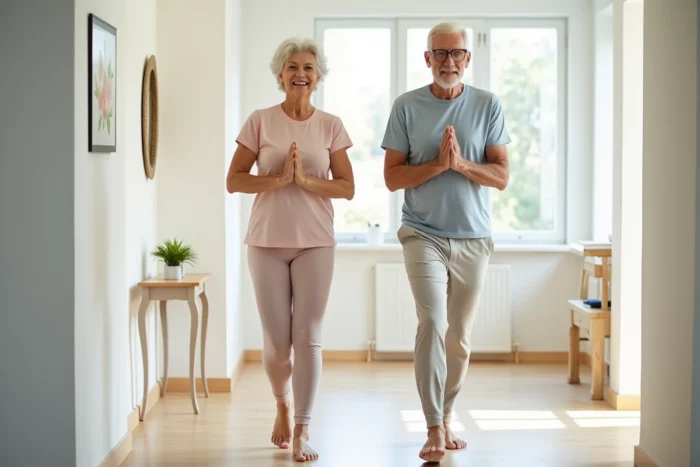
Gentle Gym for Seniors: Adjusting Intensity Without Giving Up Progress
The most common pitfall in home programs for seniors is stagnation. Once the initial exercises are mastered, many practitioners repeat the same session for months without increasing difficulty. The body adapts, and benefits plateau.
Progress does not come from heavy loads. It comes from simple variables: reducing support (two hands on the chair, then one, then a finger), increasing hold time (maintain the single-leg stance for 10 seconds, then 20), adding a movement to the sequence.
A program that does not progress in difficulty every three to four weeks loses its protective effect. This principle applies to all three profiles in the table, including the recovering fragility profile, where progress can be as modest as moving from 5 to 8 seated repetitions.
Home physical activity for seniors does not need to be spectacular to be effective. It must correspond to the actual level of the body practicing it and evolve with it. The most reliable selection criterion remains the functional capacity of the day, not the birth date.