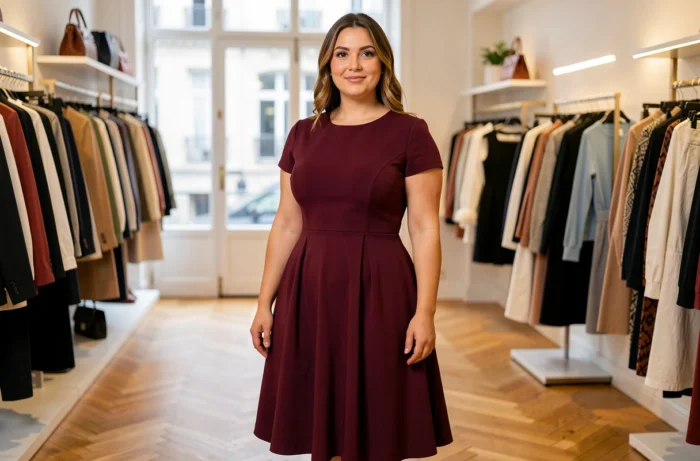
The pear-shaped breast concentrates its volume in the lower pole of the breast, with a less filled upper cup and maximum projection below the nipple line. This tissue distribution imbalance modifies the behavior of the breast in clothing and in the bra. Here, we discuss the technical choices that make a difference in wear, beyond generic recommendations on necklines.
Structured fabrics and garment construction for pear-shaped breasts
The choice of fabric takes precedence over the cut. A top made of fluid viscose or fine jersey will hug the lower part of the breast without supporting the upper volume, which accentuates the downward mass effect. We recommend materials with a firm hold: thick cotton, poplin, crepe with a sufficiently dense weight, or blends containing elastane coupled with structured polyester.
The lining of the bodice also changes the game. A top lined in the chest area, even partially, creates a smooth surface that visually redistributes the volume. Unlined tops in soft fabric produce the opposite effect: the textile deforms at the point of maximum projection and highlights every asymmetry.
Knowing how to highlight a pear-shaped breast also involves the construction of darts. A garment with well-placed breast darts (starting from the side seam towards the apex of the breast) absorbs the lower volume without compressing the top. Cuts without darts, like a straight t-shirt, allow the fabric to float above the nipple and sag under the breast.
Bras suitable for pear shape: cups and underwires
The balconette remains the most effective cut for this type of breast morphology. Its underwire rises less high on the breast than that of a full-coverage bra, which avoids emptiness at the top of the cup. The horizontal neckline line rebalances the upper volume/lower volume ratio by creating a rounded shape in the upper part.
The plunge bra works on a similar principle, with a slightly more covering cup. We observe that models with three-section cups (two side pieces and one central piece) offer better centering of the breast than two-part cups.
Straps and underband
Wide straps slightly closer together towards the center of the back exert a vertical pull that compensates for the natural tendency of the pear-shaped breast to fall outward. The underband provides most of the support: it should be firm, horizontal at the back, without riding up.
- Balconette or three-section plunge cup to fill the top of the breast without emptiness
- Underband adjusted to the loosest notch at purchase (to compensate for fabric stretch)
- Adjustable straps positioned between the middle of the shoulder and the base of the neck, never too far apart
- Light push-up acceptable to raise the point of projection, provided the padding does not compress the base of the breast
A smooth, seam-free padded bra is suitable if the cup follows the natural shape of the breast. Beware of overly rounded cups that create empty space at the top and flatten the lower volume.
Necklines and top cuts that rebalance the silhouette
The open V-neck elongates the bust and diverts the gaze towards the center of the breast, where the volume is lesser. The angle of the V should drop low enough to create a vertical axis, without exposing the inter-mammary groove.
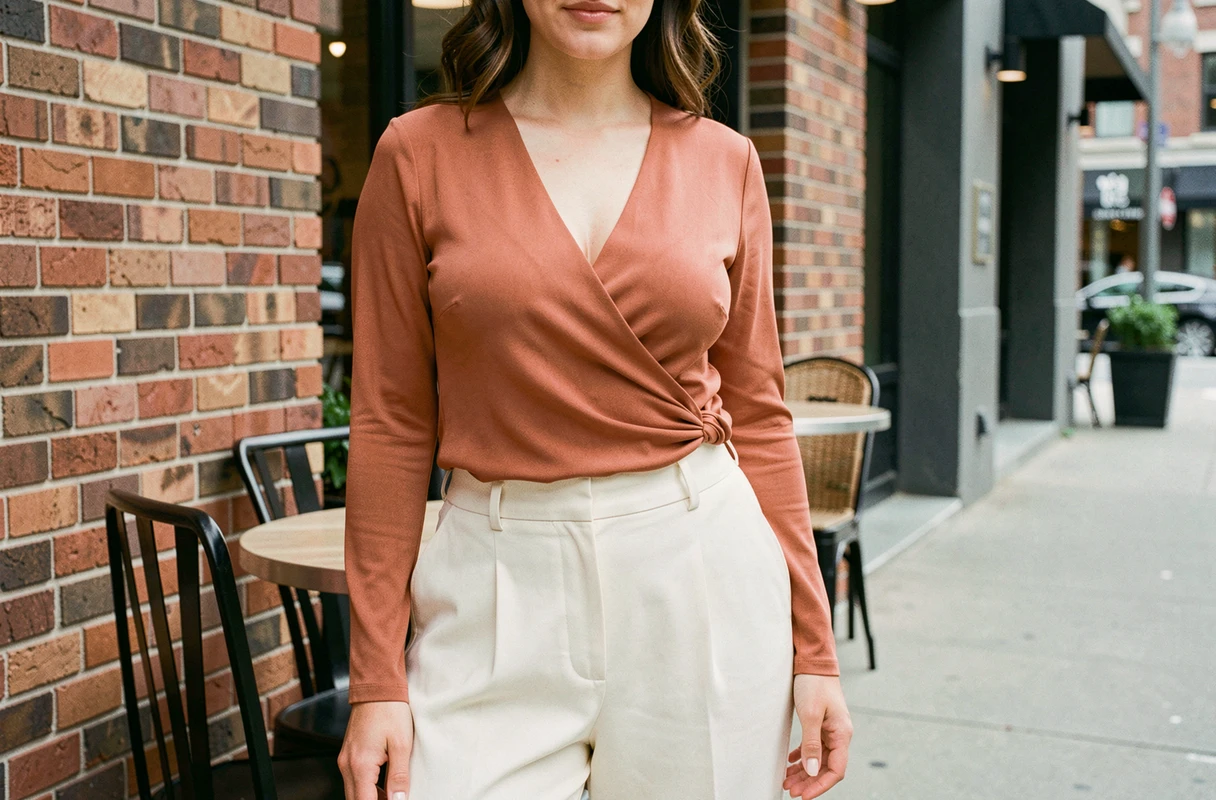
The wrap top is particularly suitable. Its fabric crossover on the chest creates a diagonal fold that structures the lower volume while covering the upper bust. We recommend models with a crossover point located just above the inframammary line, not at the waist (which leaves the bust without structure).
Necklines to avoid
The boat neck and high collar add horizontal volume at the shoulders and upper torso, which accentuates the contrast with the lower breast area. The visual result is a bust that appears heavier. Crew neck tops also cut verticality and compress the silhouette at the breast level.

Testing the garment in motion: a neglected technical criterion
Judging a garment only while standing in front of the mirror is not sufficient for a pear-shaped breast. Testing while seated reveals flaws that standing hides: the fabric creases under the breast, the neckline gapes, and the underband of the bra rides up.
In a seated position, the pear-shaped breast compresses against the rib cage and pushes the volume to the sides. A top that fit well while standing may then create a lateral mass effect. Fitted cuts with side darts absorb this displacement better than a straight garment.
Walking causes a more pronounced swinging motion on a pear-shaped breast than on a round breast, due to the low center of gravity. If the garment visibly follows this movement, the support is insufficient. A good test is to take a few steps and check that the fabric remains stable at the bust level.
- Check the drape of the fabric sitting, standing, and in motion before purchase
- Observe if the neckline opens when leaning forward
- Ensure that the underbust seam remains horizontal when seated
The pear-shaped breast requires more precise choices in cut and material than other breast morphologies. Favoring structured fabrics, a three-section cup, and V-necklines resolves most shaping and support issues. The movement test remains the final filter to distinguish a well-fitting garment from one that truly enhances the silhouette.