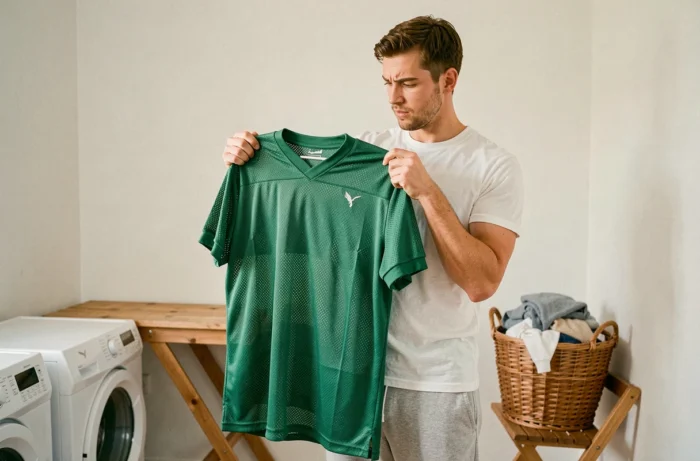
You receive a football jersey ordered online, put it on, and the fabric floats at the hips like a bag. The problem often arises with club or national team jerseys: sizes vary from one brand to another, and an oversized jersey ruins comfort as much as the look. Adjusting an oversized football jersey requires specific precautions, especially when wanting to preserve prints and badges.
Prints and heat-pressed badges: the constraint that tutorials overlook
Most alteration guides talk about sewing or washing at high temperatures without mentioning a concrete risk: the prints, sponsors, and heat-pressed badges on a football jersey cannot withstand the same treatments as bare fabric. A too-hot tumble dryer or a misplaced iron can detach a sponsor, crack a number, or distort a badge.
Before touching anything, turn the jersey inside out and identify each glued or heat-pressed element. The at-risk areas are the chest (main sponsor), the back (name and number), the sleeves (competition logos), and sometimes the bottom of the jersey.
Any alteration must avoid these areas, not cross them. If you plan to adjust the side seams, check that no heat-pressed element is in the seam allowance. If you think about shrinking it through washing, forget the high-temperature tumble dryer: the synthetic fibers of the jersey will react little, but the glue of the prints can give way.
To find more tips for adjusting a jersey, this zone-based approach remains the foundation before any manipulation.
Diagnosing excess fabric before any alteration
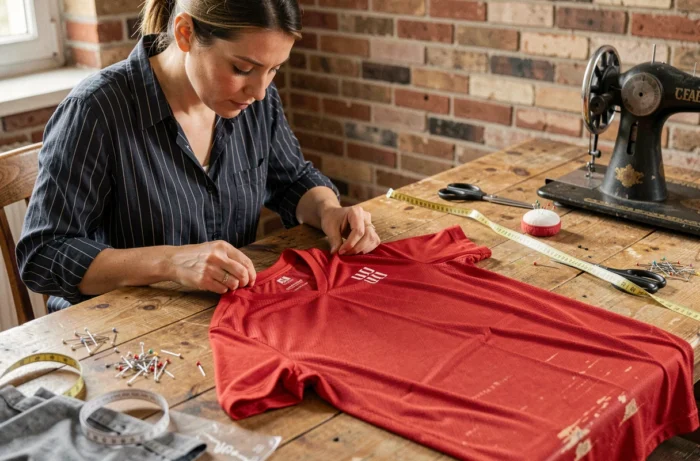
You do not alter a jersey that is too wide at the shoulders the same way as a jersey that is too long in the torso. A precise diagnosis of the excess prevents cutting in the wrong place and ending up with an asymmetrical jersey.
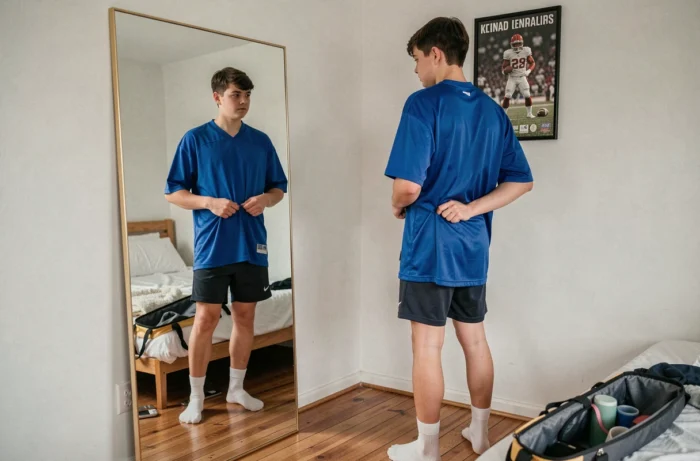
Put the jersey on inside out. In front of a mirror, pin the excess fabric without pulling the material, following the natural line of the body. The goal is to visualize exactly where the excess is concentrated.
- Excess at the shoulders and sleeves: the shoulder seam falls too low, the sleeves extend beyond the biceps. The adjustment is made on the shoulder seam, shifting the armhole inward.
- Excess at the bust and waist: the jersey floats at the sides. Adjust the side seams, distributing the same amount on each side to maintain symmetry.
- Excess in length only: the jersey hangs too low. A hem is sufficient, provided you do not cut into a sponsor placed at the bottom of the jersey.
Pinning on the inside is the only reliable method to measure the actual excess without distorting the fabric. You do not guess by eye, you do not mark flat on a table: the drape changes as soon as you wear the garment.
Sewing on a synthetic fabric jersey: settings and precautions
Football jerseys are almost always made of polyester or a polyester-elastane blend. This type of fabric slips under the presser foot and melts under a too-hot needle. Alteration by sewing works very well, but it requires some adjustments not found in tutorials designed for cotton.
Use a stretch fabric needle (rounded tip) that pushes the synthetic fibers apart instead of piercing them. A standard needle can create small visible holes on a shiny jersey. Polyester thread is the logical choice: same material, same behavior in washing.
Always baste by hand before machine sewing. Basting is a temporary stitch with long stitches that allows you to try on the adjusted jersey before finalizing. If the jersey is too tight at the armpits or restricts arm movement, correct it before cutting the excess fabric.
A narrow zigzag stitch or stretch stitch is better than a classic straight stitch. Polyester has slight elasticity, and a rigid straight stitch risks breaking when you pull the jersey over your head.
Where to cut, where not to cut
Once the basting is validated, cut the excess, leaving a margin of at least one centimeter. On a football jersey, overlock the cut edge with a zigzag stitch to prevent the polyester from fraying in the wash.
Never cut through a print or badge. If the excess fabric passes under a side sponsor (common on recent jerseys with sponsors on the sides), shift the sewing line to avoid the area. Opinions vary on this point, but folding the fabric under the glued element without sewing it directly usually gives a clean result.
Shrinking a football jersey in the wash: what works and what damages
Washing at high temperatures is the first idea that comes to mind. On a polyester jersey, the shrinking effect remains very limited. Synthetic fibers are designed to withstand moderate heat and return to their original shape.
A wash at the maximum temperature recommended on the label (often 30 or 40 degrees for a football jersey) will produce almost no change in size. Going up to 60 degrees may slightly tighten the fabric, but the gain is measured in a few millimeters, not half a size.
The high-temperature tumble dryer is more aggressive. It can reduce the jersey a bit more, but this is also where the prints and badges start to peel off. Prolonged heat softens the thermofusible glue and causes partial detachments, especially on the edges of letters and numbers.
If you are keen on heat shrinking, a compromise is to wash the jersey turned inside out at a moderate temperature, then dry it flat. You protect the prints from direct contact with heat, but you accept that the result will be subtle.
Non-sewing tips for wearing an oversized jersey
When you do not want to alter the jersey (collection jersey, vintage jersey, piece with sentimental value), a few temporary solutions can improve the fit without permanent alteration.
- Tuck the bottom of the jersey into the shorts by creating a regular fold at the waist. Distribute the excess on the sides rather than at the front to avoid a visible bulge.
- Use a thin elastic tied inside at the waist to tighten the jersey without sewing. The elastic can be removed in two seconds.
- Wear a fitted undershirt underneath. The oversized jersey retains its volume but does not float as much, because the fabric grips on the undershirt instead of sliding on the skin.
These solutions do not alter the fabric or the prints. They are reversible, which matters when you hesitate to alter a jersey that you won’t find again in stores.
Adjusting an oversized football jersey comes down to a choice between permanent alteration and temporary adaptation. In both cases, the reflex to keep is to protect the heat-pressed elements before any manipulation. A well-fitted jersey but with peeling prints after the first wash is a failed alteration.