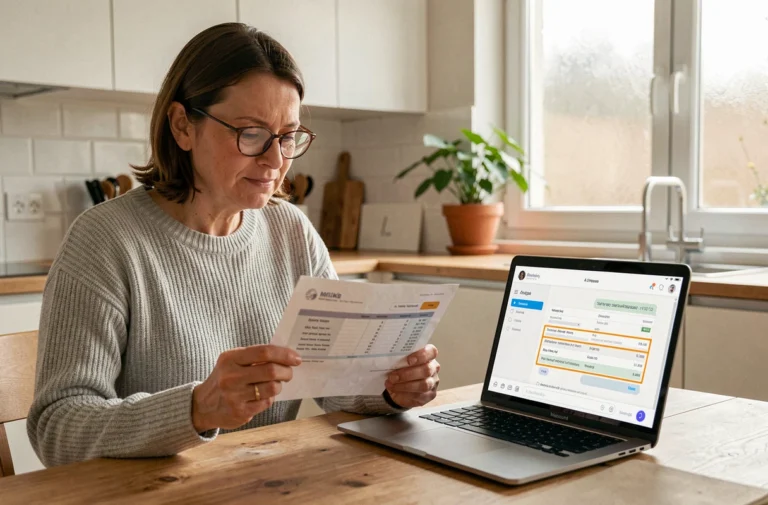
One Monday morning, the accountant at a 12-person small business receives an email from its payroll software provider. The message asks them to verify new bank details. The link leads to a page that looks identical to the provider’s website.
Two clicks later, a third party has the login credentials. This scenario is far from unusual: in its 2024 report, Cybermalveillance.gouv.fr ranks account theft among the most common risks for businesses, alongside phishing and ransomware.
Identify the source of an incident in under an hour
When an alert comes in (a suspicious login, an encrypted file, a data leak), the first priority isn’t to shut everything down. It’s to work out whether the problem originated on an employee’s device, from a compromised account, or with an external provider. Every decision that follows depends on the answer.
Start by checking the login logs for email and business applications. Access from an unknown IP address or an unusual country points to a compromised account. If the logs show normal user activity but data was transferred through a third-party tool’s API, the provider becomes the focus.
ANSSI’s 2025 Cyber Threat Overview, published on March 11, 2026, describes an increase in data exfiltration incidents and double- and even triple-extortion scenarios. Knowing which data was exposed matters just as much as restoring systems. When ransomware strikes, the pressure is no longer limited to encryption: attackers also threaten to make the data public.
For more on protection practices suited to small organizations, the resources collected on security on Planet X Tech cover several practical scenarios that are useful day to day.
Who decides what in the first few hours
In a small organization, three roles are enough to structure the response: the person who spots the incident (often a user), the IT lead (in-house or an outsourced IT provider), and the business owner who authorizes containment measures. If no one has this mandate in writing, confusion delays every action.
A one-page decision chart, accessible offline, speeds up the response. It specifies who isolates a device, who contacts the provider, and who notifies the CNIL if personal data is involved. Test the document once a year using a 20-minute fictional scenario.

Two-factor authentication and its limits against targeted attacks
Enabling MFA on every business account is still a basic security measure. But treating it as absolute protection can create a false sense of security. ANSSI’s 2025 overview describes social engineering techniques designed to bypass MFA by exploiting knowledge of an organization’s internal processes.
An attacker calls an employee pretending to be from IT support, asks them to approve a push notification, and gains access. The answer isn’t another technical layer but an operational principle: verify every unusual request through a different channel. Call the person directly, message them on another platform, or confirm in person.
Three additional measures help reduce the remaining risk:
- Restrict administrative privileges to accounts that genuinely need them, and review the list every quarter.
- Set up alerts for unusual behavior: simultaneous logins from two countries, bulk file downloads, or changes to email forwarding rules.
- Prioritize email accounts, which are used to reset passwords for most other services.
Security for IT providers and subcontractors
A compromised SaaS provider can give attackers access to all its customer organizations in a single operation. The NIS 2 Directive extends security obligations to a wider range of organizations, beyond traditionally regulated operators. However, the French regulatory landscape is still evolving: the Resilience Bill is continuing through the parliamentary process, and its measures should not be presented as already in force at this stage.
In practice, there’s no need to wait for the law to take action. Reviewing security and business continuity clauses in supplier contracts is simply good operational practice. Ask every critical IT provider these three questions:
- What intrusion detection measures are in place, and how quickly does the provider notify clients of an incident?
- Are backups kept separate from the main system, and has a restore test been carried out in the past six months?
- Is a dedicated contact available outside business hours for security incidents?
If the provider can’t give clear answers to all three questions, it’s worth reassessing the risks of relying on them.

Business email: the first link in the chain attackers target
Email brings together account access, sensitive communications, and password reset links. It’s the preferred entry point for phishing campaigns—and the gateway to everything else if it’s compromised.
Keeping personal and business email accounts separate isn’t just theoretical advice: it’s the first line of defense against lateral movement. A password compromised on an online shopping site should never give access to the account used to manage supplier payments.
Beyond using a unique, strong password for every service, email server configuration also plays a direct role. Enabling SPF, DKIM, and DMARC helps limit spoofing of outgoing emails. These technical settings take less than an hour to configure and reduce the risk of recipients seeing spoofed emails.
Training teams is still worthwhile, as long as it goes beyond general advice. A quarterly simulated phishing exercise followed by a 10-minute debrief produces more lasting results than an annual awareness day that everyone forgets the following month.
Digital security doesn’t improve by piling on more tools. It gets stronger when everyone in the organization knows what to check, who to notify, and what order to act in. An incident response document, three questions for providers, and verification through a second channel: these are simple steps, but they make all the difference to response times when an incident actually occurs.