The choice of stabilizer, the density of stitches, and the type of thread have a much greater impact on the durability of embroidery on knitted fabric than the design itself. Creating a custom embroidered beanie that withstands washing and maintains its shape requires mastering a few technical parameters that general guides often overlook.
Stabilizer and hoop: the technical duo that determines the quality of embroidery on beanies
The knit of a beanie, whether ribbed or jersey, deforms under the tension of the hoop. A poorly chosen stabilizer results in uneven stitches, fabric wrinkling after removing the hoop, or even permanent deformation of the beanie.
We systematically recommend a medium-weight cutaway stabilizer as a base, paired with a water-soluble stabilizer placed on top of the knit. The first prevents the fabric from sinking into the needle plate. The second prevents the stitches from getting buried between the loops of the knit.
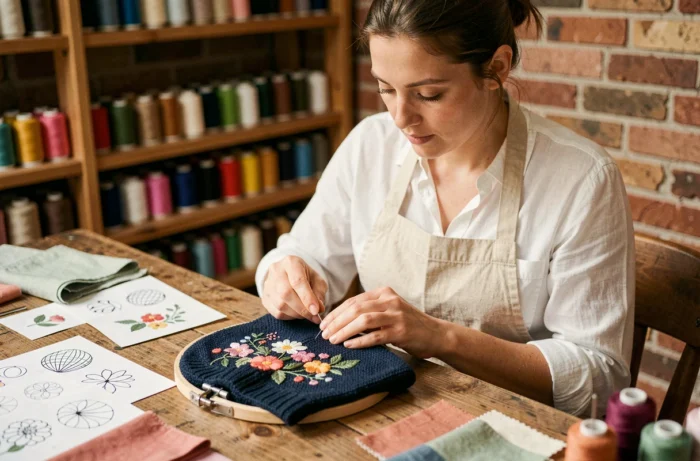
The hoop should hold the stabilizer, not the beanie. Stretching the knit directly in the hoop irreversibly deforms the knitted structure. The technique involves hooping the cutaway stabilizer alone, then pinning or temporarily repositioning the beanie on top with a repositionable adhesive. Creating a custom embroidered beanie on Belle et Bien follows this same logic of preparing the support before any machine work.
The choice of hoop also matters. A hoop that is too large allows for movement and causes registration shifts between colors. A compact hoop, suitable for the embroiderable area (usually the front area of the beanie, between the cuff and the top), yields a much sharper result.
Stitch density and digitization of the design for knitted fabric
A vector file is not enough to embroider on a beanie. The digitization of the design must be specifically configured for a stretchable textile support. Default settings, designed for woven cotton, produce poor results on knit.
Three parameters to adjust during digitization:
- Pull compensation: the knit stretches under the tension of the embroidery thread, which shrinks the design horizontally. Increasing the width of the satin columns compensates for this phenomenon.
- The underlay: on knit, a crossed or grid underlay stabilizes the surface before the cover stitches are applied. Without it, the stitches sink into the gaps of the knit, and the design loses definition.
- Stitch density: unlike flat fabric, knit requires a slightly reduced density. Too many stitches per centimeter stiffen the embroidered area, create a cardboard effect, and can even pierce the fibers of the knit.
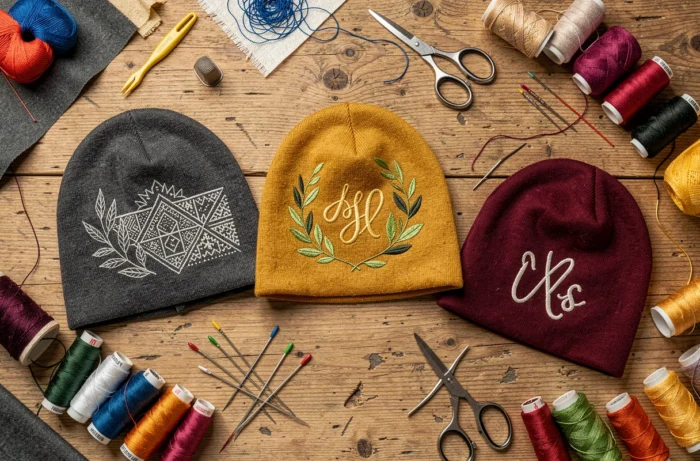
Highly detailed designs (gradients, shading, small characters under a few millimeters in height) should be avoided. The texture of the knit absorbs fine details. We observe the best results with bold designs and solid colors, typically a simplified logo or lettering in capital letters at least eight millimeters high.
Polyester thread or viscose thread on beanies
Polyester thread withstands repeated washing and friction better. Viscose thread offers a shinier appearance but does not hold up well to high-temperature machine cycles. For a beanie intended for daily outdoor use, polyester remains the default choice.
A ballpoint needle is non-negotiable on knit. A standard needle pierces the fibers instead of pushing them apart, which weakens the knit around the embroidered area.
Regulatory constraints for the sale of custom beanies in France
Workshops and shops that sell custom embroidered beanies face a strengthened regulatory framework. As of January 1, 2025, textile waste must be sorted separately by companies, with a dedicated collection system and traceability documents kept in case of inspection. Thread scraps, beanies downgraded due to embroidery defects, and unsold items fall under this obligation.
The AGEC law also requires textile product marketers to provide dematerialized environmental information: countries of the main manufacturing stages (knitting, dyeing, finishing, marking), share of recycled materials, presence of synthetic microfibers. A QR code on the label or an online sheet is sufficient, but the information must be accessible to the consumer before purchase.

Fast fashion law and display of the manufacturing location
The text enacted on July 8, 2026, creates an additional obligation for online sales: manufacturing locations must be displayed close to the price, in a font size at least equivalent. A beanie knitted in Portugal, embroidered in France, and sold on an e-commerce platform must clearly mention these two stages on the product sheet.
As of January 1, 2027, any advertising for products related to the so-called ultra-fast fashion practice will be prohibited in the media. Small customization workshops are not directly targeted, but the traceability of the production chain becomes both a commercial argument and a legal obligation.
Choosing the raw beanie: material and shape suitable for embroidery
A cheap acrylic beanie is easy to embroider but pills after a few washes, which degrades the design’s appearance. A merino wool beanie offers a better drape, but the natural fiber deforms more under the hoop.
The most reliable compromise for embroidery remains a blend of acrylic and wool or a thick cotton in jersey knit. Tight ribbed knit also works, provided the underlay is adjusted to compensate for the vertical grooves.
The shape of the beanie influences the embroiderable area. A short docker beanie limits the height of the design. A cuffed beanie provides a natural flat surface on the fold, ideal for a small centered logo. A slouchy beanie, being roomier, tolerates larger designs but complicates the hooping process.
Embroidery on beanies remains a technical operation where the preparation of the support and the quality of the digitization weigh more heavily than the choice of design. A well-configured file, an appropriate stabilizer, and a ballpoint needle are enough to transform a raw beanie into a durable accessory, provided one does not attempt to reproduce on knitted fabric what only works on flat fabric.