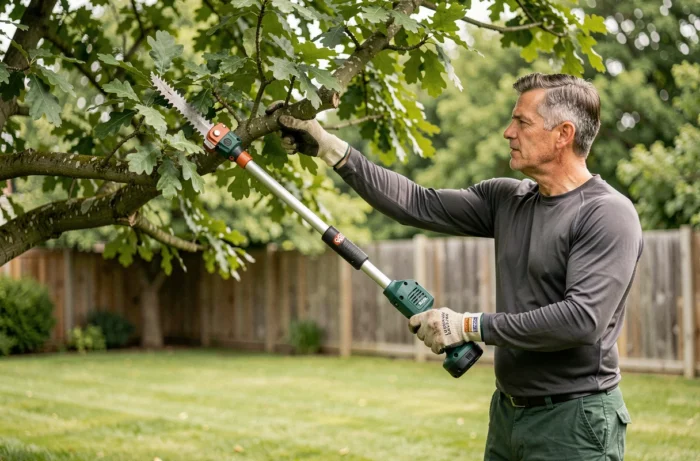
Choosing a pruner involves balancing engine power, guide bar length, and power type. These three parameters alone determine cutting capacity, ease of use, and the overall cost of the tool. Rather than listing all the models on the market, this article compares the technical data that truly separates the major families of pruners.
Gas, battery, or corded pruner: comparative table of power types
The type of power source affects autonomy, weight in hand, and noise level. Here are the concrete differences between the three available families.
| Criteria | Gas | Battery (lithium-ion) | Corded |
|---|---|---|---|
| Autonomy | Unlimited (tank) | Limited by battery capacity | Unlimited (mains) |
| Perceived weight | Heavier (engine + fuel) | Intermediate | Light (compact engine) |
| Noise level | High | Low to moderate | Moderate |
| Range | Total | Total | Limited by the cord |
| Engine maintenance | Spark plug, filter, carburetor | Almost none | Almost none |
| Typical use | Professional, large sections | Homeowner and light professional | Small garden, low hedges |
Gas models remain the reference for cutting thick branches far from any electrical outlet. However, battery-powered pruners are rapidly increasing in power and are appealing due to their low noise, a significant advantage in residential areas where regulations govern noisy work hours.
A criterion rarely highlighted in buying guides deserves attention: the compatibility of batteries between multiple tools. Several manufacturers offer modular systems where the same battery powers pruner, chainsaw, hedge trimmer, and blower. In the long term, this choice reduces the overall equipment cost. You will find detailed comparisons of models on elagueuse-warrior.com, allowing you to check the compatibility of a range before purchase.

Guide bar and engine displacement: the data that separates a classic pruner from a pole saw
Two categories dominate the market: the compact pruner known as “top handle” and the pole pruner. Their design caters to distinct uses, and confusing them can lead to a poor purchase.
Compact top handle pruner
Designed to be operated one-handed at height, it features a top handle and a short guide bar. Its use on the ground is prohibited in France: it is reserved for work in a lift, on a secure ladder, or harnessed in a tree. Common displacements on gas models range from 25 to 35 cm³, with guide bars of 25 to 30 cm.
This format is suitable for pruning branches of small to medium diameter. Its lightness is its main asset: holding a heavy tool at arm’s length for several hours strains the joints and increases the risk of falling.
Telescopic pole pruner
The pole pruner allows reaching high branches without leaving the ground. The length of the pole varies by model and can exceed three meters, providing significant reach when adding the user’s height.
The compromise lies between reach and maneuverability. The longer the pole, the more the lever arm fatigues the arms and reduces cutting precision. For a homeowner maintaining a few fruit trees, an average-length pole is usually sufficient. Professionals working on large subjects often prefer to climb with a compact pruner.
Chain, pitch, and gauge: cutting parameters to check before purchase
Cutting performance does not solely depend on engine power. Three chain characteristics directly influence the result.
- The chain pitch (distance between links) determines cutting speed and the fineness of the cut. A reduced pitch produces a cleaner cut with less vibration, suitable for small green branches.
- The gauge (thickness of the drive link) must exactly match the groove of the guide bar. Incompatibility causes derailment or premature wear.
- The profile of the cutters (semi-chisel or full chisel) changes the behavior in wood. The semi-chisel tolerates dirty or frozen wood better, while the full chisel cuts faster in clean wood but dulls more quickly.
When replacing the chain, it is essential to respect the trio of pitch/gauge/number of links indicated by the manufacturer. Installing an incompatible chain compromises safety and voids the guide’s warranty.

Noise regulation and neighborhood: an underestimated choice criterion for the pruner
Noise nuisances related to gardening tools are regulated by municipal decrees that vary from one municipality to another. Authorized time slots are generally restricted on weekends and holidays. Fines for neighborhood disturbances can reach several hundred euros, and repeated complaints can permanently damage neighborly relations.
This context directly influences the choice of power source. A gas pruner generates a noise level significantly higher than that of a battery model. For a homeowner who primarily prunes on Saturday mornings, choosing a lithium-ion battery reduces the risk of conflict while providing sufficient power for branches of common diameter.
The European directive on noise emissions from equipment used outdoors also imposes thresholds on manufacturers. Recent battery ranges are well below these limits, which expands the allowable usage hours without violating local regulations.
The choice of a pruner rarely comes down to power alone. Chain compatibility, format (compact or pole), modular battery system, and noise level weigh as heavily over time as the displacement listed on the technical sheet. Checking these technical parameters before purchase avoids disappointments once perched in the tree.