
The Prado program, managed by Health Insurance since 2010, organizes the return home of hospitalized patients. Its principle: a CPAM advisor intervenes before discharge to coordinate medical follow-up in the community. Behind this simple presentation, the actual access criteria remain unclear for many insured individuals, and the system does not operate in the same way depending on the reason for hospitalization.
Prado by pathology: very different follow-up pathways
Prado is not a uniform service. It is divided into several distinct components, each with its own coordination logic and involved healthcare professionals. Grouping all situations under the label “return home after hospitalization” masks very heterogeneous realities.
The maternity Prado, launched first, targets early discharges after childbirth. It relies on free home visits by a midwife, scheduled as soon as the patient is in maternity care. The goal is to secure the first days of returning home with the newborn, particularly for monitoring the mother and supporting breastfeeding.
The surgical component, gradually expanded since 2012, initially covers orthopedics and then all surgical procedures. Follow-up here involves the attending physician and, depending on the intervention, a nurse or a private physiotherapist.
Pathways for chronic conditions (heart failure, COPD) were rolled out starting in 2013. They aim to reduce readmissions by structuring close follow-up in the community. For patients who have suffered a stroke or transient ischemic attack, the CPAM advisor coordinates rehabilitation and neurological follow-up appointments after discharge.
Patients receiving medical and rehabilitation care (SMR) or hospitalized for Covid are also among the targeted populations. The possibility of benefiting from the CPAM Prado program therefore primarily depends on the clinical reason that led to hospitalization.

Prado eligibility criteria: what the medical team really evaluates
Enrollment in Prado is not an administrative choice of the patient. It is the hospital medical team that declares the patient eligible, by crossing several criteria before forwarding the file to the Health Insurance advisor.
The criteria are not solely medical. The evaluation focuses on three dimensions:
- The patient’s health status, which must allow a return home without major risk identified by the care team
- The degree of autonomy: ability to move, manage daily care, presence or absence of a caregiver at home
- The social and logistical context: accessibility of the housing, availability of nearby community healthcare professionals, potential isolation
A patient who meets the medical criteria but lives alone in an area where no private nurse is available may be directed to another solution. However, age alone is not an exclusion criterion: the surgical component concerns both patients aged 40 and those over 75.
The patient retains the right to refuse the system. Prado is based on volunteerism, and the insured chooses the healthcare professionals who will follow them in the community.
Affiliation regime and geographical coverage: two often overlooked filters
The majority of information available on Prado concerns the general regime. In practice, access to the program also depends on the insured’s affiliation regime. The ENIM (maritime regime), for example, has formalized its own Prado offer for its affiliates and their beneficiaries, which expands the scope beyond just CPAM insured individuals.
Other special regimes may offer equivalent systems or grant access under certain conditions. Field reports vary on this point: not all regimes have integrated Prado at the same pace or with the same scope of covered pathologies.
The second filter is geographical. Prado is not offered in all healthcare facilities. Deployment remains gradual across the territory. A patient hospitalized in a non-contracted facility simply will not be offered the service, regardless of their health status.
This territorial disparity creates unequal access to the system. It weighs particularly heavily in rural areas or small hospitals, where the presence of a trained Health Insurance advisor for Prado is not systematic.
Concrete implementation of Prado: from hospital bed to community follow-up
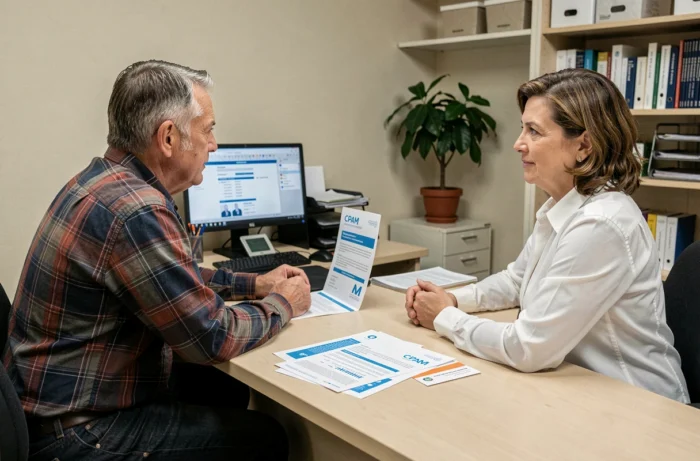
Once eligibility is validated by the medical team, a Health Insurance advisor visits the patient during their hospitalization. This meeting serves to gather their wishes, identify their attending physician, and the community healthcare professionals they prefer.
The advisor then organizes contact with these professionals so that the first appointment takes place quickly after discharge. For maternity Prado, the midwife’s first visit occurs in the days following the return home. For a post-stroke pathway, rehabilitation and neurological follow-up appointments are planned in advance.
The attending physician remains the pivot of follow-up once the patient is back home. The program does not replace the usual care pathway: it structures the transition between hospital and community medicine to avoid gaps in care.
In terms of financing, consultations and procedures carried out within the framework of Prado are covered under the usual conditions of Health Insurance. The program itself does not generate any additional out-of-pocket expenses for the patient.
What Prado does not cover
The system does not cover housing adaptations or material assistance at home. For elderly patients requiring modifications, other systems exist, such as assistance for returning home after hospitalization managed by pension funds. Prado coordinates medical follow-up, not overall social support.
The confusion between these two types of aid remains common, particularly among family caregivers who expect broader coverage. The CPAM advisor can direct to the right contacts, but their role is limited to coordinating community care.
The Prado program has evolved since its inception by gradually integrating new populations and new pathologies. Its real usefulness depends on the combination of the reason for hospitalization, the location of care, and the actual availability of healthcare professionals in the community, three variables that the patient does not always control at the time of discharge.