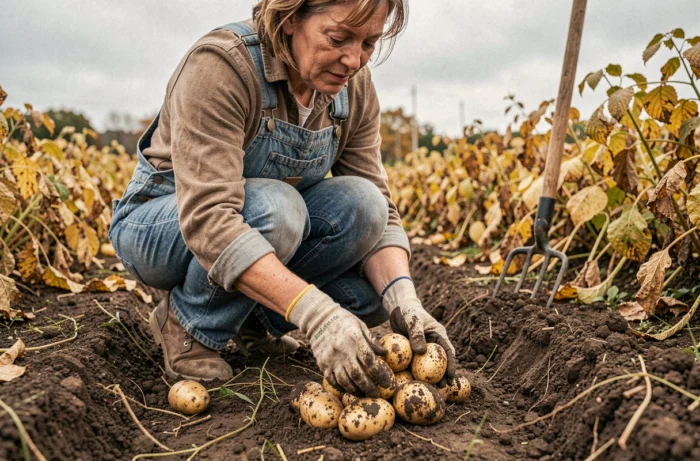
The potato signals its maturity underground, invisible. The only reliable indicator remains the state of the aerial foliage, but for the past few summers, heatwave episodes have muddied this signal by causing early yellowing related to water stress, not to the actual maturity of the tuber. Knowing how to distinguish between the two avoids harvesting too early or letting plants that are already ready rot.
Thermal stress and false yellowing of foliage
Classic guides describe a simple pattern: when the leaves yellow and lie down, the tubers are ripe. This marker remains valid under normal conditions, but it becomes misleading during a heatwave summer.
In Hauts-de-France, the leading producing region, the yields of summer 2026 are among the lowest in thirty years. According to Franceinfo, heat spikes have accelerated the growing cycle and forced producers to harvest everything much earlier than usual, including storage varieties. The tubers remain smaller, and the size decreases.
In the vegetable garden, the same phenomenon occurs on a smaller scale. Yellowing foliage due to heat does not always mean maturity has been reached. To decide, simply dig up a test plant: if the skin of the tuber comes off when rubbed with the thumb, the harvest is premature. A firm skin that resists rubbing confirms that the tuber has finished forming.
Knowing when to harvest potatoes in the garden therefore requires cross-referencing two pieces of information: the appearance of the foliage and the resistance of the skin, especially when the weather imposes unusual temperatures.
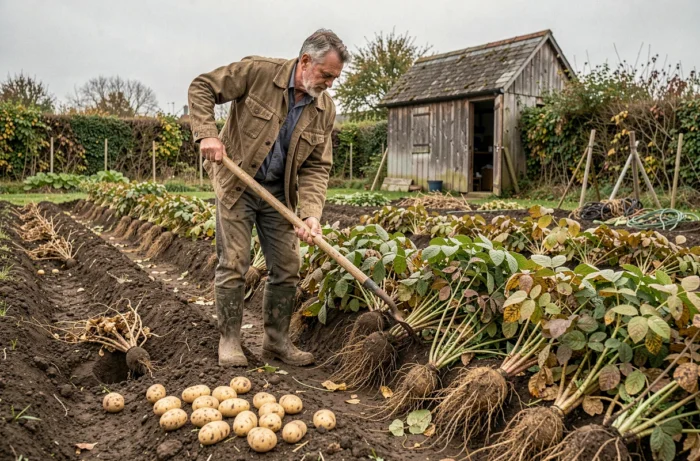
Skin test: the technical gesture that ensures reliable harvesting
The skin test is the most direct method to assess the maturity of a tuber without relying solely on the foliage. It is performed on a single plant, without compromising the rest of the plot.
- Choose a representative plant, neither the most vigorous nor the weakest, at the edge of the row to limit disturbance to neighboring roots.
- Gently clear the soil around the plant by hand or with a flat-tined fork, never with a sharp tool that could damage the tuber.
- Rub the skin of the largest tuber with your thumb: if it peels like paper, replace the soil and wait another one to two weeks.
- Repeat the test after this period. A skin that stays in place indicates that the tuber is ready for harvest and storage.
This gesture takes less than a minute and avoids two common mistakes: harvesting immature tubers that will not store well, or leaving mature plants in the ground exposed to blight or rodents.
Blight on foliage: mow before harvesting
Blight (Phytophthora infestans) manifests as brown spots on the leaves, often accompanied by a whitish felt on the underside in humid weather. If the foliage is affected, it must be cut down to the ground before uprooting the tubers.
The goal is to prevent spores from descending to the tubers via rainwater or irrigation. Once the foliage is cut, waiting about ten days before harvesting allows the skin of the potatoes to harden (a process called suberization), which reduces the risk of infection during storage.
Bordeaux mixture applied preventively can slow the spread of blight on the leaves, but it does not cure an already infected plant. In the case of a declared attack, the only effective response in the vegetable garden remains the quick mowing of the foliage.
Common mistake after mowing
Many gardeners harvest immediately after cutting the diseased foliage. The tubers then come out with a thin and fragile skin, which gets damaged at the slightest shock. Two weeks of waiting in the ground (drained soil, no watering) is enough for the skin to thicken and protect the flesh during storage.
Soil conditions and weather on the day of harvest
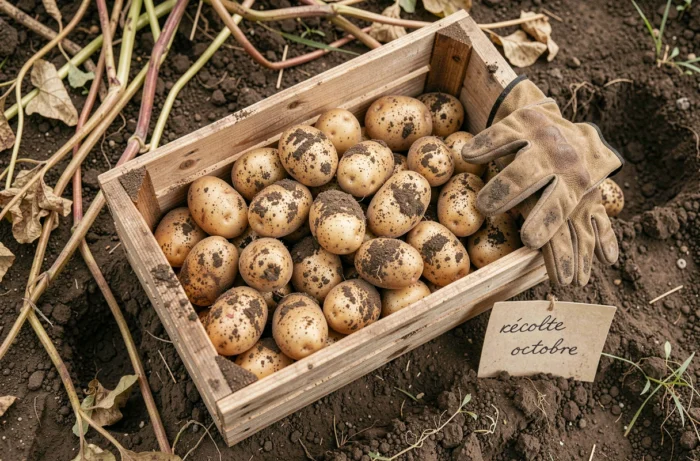
The quality of potato storage is largely determined on the day of uprooting. Harvesting on wet soil increases the risk of rot during storage.
Waiting for a dry spell, ideally after two or three days without rain, makes the work easier and allows the tubers to dry on the surface before being brought in. Leaving the potatoes spread out on the ground for a few hours after uprooting helps to remove excess soil and to spot any damaged or green tubers, which should be discarded immediately.
Green tubers: toxicity from solanine
A tuber exposed to light, whether in the field or in storage, develops chlorophyll on the surface and, at the same time, solanine, a toxic alkaloid. The green color serves as a visible indicator. These tubers should not be consumed, even after thick peeling, as solanine also concentrates in the superficial flesh.
During harvesting, the potatoes that were exposed on the surface during cultivation (insufficient hilling) are the first affected. Sorting them on-site and composting them avoids any confusion at the time of storage.
Time between planting and harvesting depending on the type of variety
The time between planting and maturity varies greatly depending on the category of the cultivated variety:
- New potatoes (Amandine, Margod) are harvested before full maturity, when the plants are still flowering, about two months after planting. Their thin skin is intended for quick consumption.
- Early varieties (Charlotte, Belle de Fontenay, Ratte) reach maturity about three months after planting, as soon as the foliage begins to yellow naturally.
- Seasonal and late varieties (Bintje, Vitelotte, Désirée) require four months or more. These are the ones best suited for long-term storage, provided the skin is well-formed at harvest.
These markers remain indicative. The skin test described above takes precedence over any theoretical calendar, especially since recent climatic variations regularly shift cycles by a few weeks in either direction.
One last point to keep in mind: a potato left in the ground does not store better. It eventually starts to grow again or attracts slugs and voles. It is better to harvest the entire row once maturity is confirmed, even if it means consuming the smallest or slightly damaged tubers first.