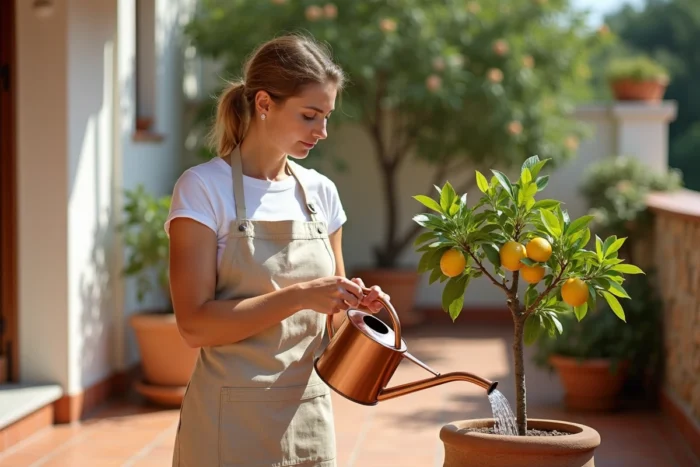
A potted lemon tree relies entirely on the person watering it. Unlike a tree planted in the ground, its roots cannot seek moisture deep down. In summer, this dependence becomes critical: heat accelerates evaporation, the substrate shrinks, and the margin between too much and not enough water narrows to just a few hours. Mastering the watering of a potted lemon tree in summer requires understanding what is actually happening in the container, not just on the surface.
Dry surface clod, waterlogged below: the summer trap of the pot
Since the repeated heatwaves, a common piece of feedback among amateur gardeners has emerged: the soil feels dry to the touch, while the clod remains soaked a few centimeters below. This discrepancy leads to daily watering, sometimes twice a day, ultimately causing the opposite of the desired result.
The scenario is documented: gardeners watering every day during a heatwave notice a massive drop in leaves. Scratching the soil of the pot reveals a waterlogged substrate beneath a hardened surface crust. Root asphyxiation due to excess water is the primary cause of summer decline in potted lemon trees, far ahead of drought.
Properly mastering the watering of a potted lemon tree in summer starts with a reliable diagnosis of the actual moisture in the substrate, not a fixed watering schedule.
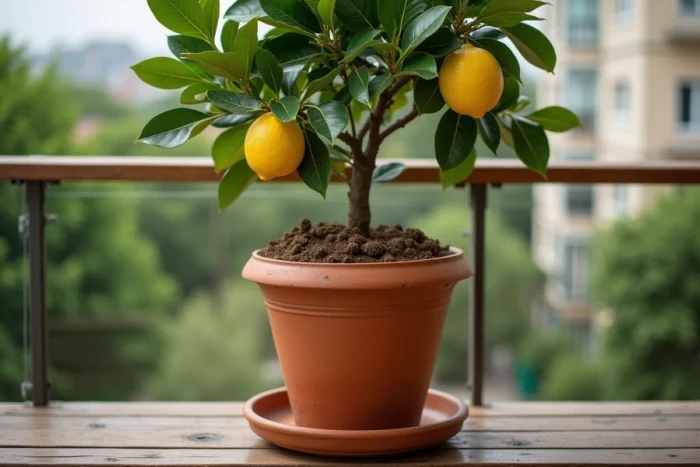
Testing moisture beyond the first two centimeters
The finger test on the surface is not enough. You need to push a wooden stick (like a skewer) down to a depth of at least five to seven centimeters. If it comes out damp or if soil sticks to it, watering is not necessary. If it comes out dry and clean, the substrate needs water.
This simple action avoids most mistakes. It takes ten seconds and is a better alternative to automatic timers that do not take into account the actual density of the substrate or the pot’s exposure.
Watering the lemon tree in a heatwave: morning or evening, the choice matters
The timing of watering is a topic of debate among gardeners. Feedback from professionals consulted by specialized publications favors early morning, before the sun heats the pot. Watering late in the evening maintains prolonged moisture around the roots overnight, which encourages the development of pathogenic fungi.
In the morning, the water has time to penetrate the substrate before evaporation accelerates. The roots absorb what they need during the first hours of heat. The excess naturally drains through the drainage holes and through gradual evaporation.
The saucer, a false ally in summer
Keeping a saucer full of water under the pot seems logical when it’s very hot. In practice, stagnant water in the saucer accelerates root rot. If you use a saucer to protect a balcony or terrace, always empty it half an hour after each watering. The lemon tree tolerates a substrate that dries partially between waterings, but not roots that are constantly submerged.
Substrate and drainage: what determines the frequency of watering
Two potted lemon trees placed side by side can have very different water needs if their substrates are not the same. A compact universal potting soil retains water for a long time, sometimes too much. A draining mix (potting soil, coarse sand, perlite, or pumice) allows water to pass through more quickly and limits the risk of asphyxiation.
The elements that modify the frequency of watering are concrete:
- The material of the pot: porous terracotta allows water to evaporate through the walls, naturally regulating humidity. Plastic retains all the water in the substrate, increasing the risk of saturation
- The volume of the container: a pot that is too small dries quickly but saturates just as fast. An appropriately sized container (at least two sizes larger than the clod) offers a more stable water buffer
- Exposure: a lemon tree facing south against a white wall receives reflected heat that can double evaporation compared to a sheltered location
- Surface mulching: a layer of mineral or organic mulch reduces superficial evaporation and limits the formation of the misleading dry crust described above
A well-composed draining substrate reduces the risk of watering errors much more than a rigid schedule. This is the first investment to make even before questioning the frequency.
Alert signs on the lemon tree: distinguishing between lack of water and excess
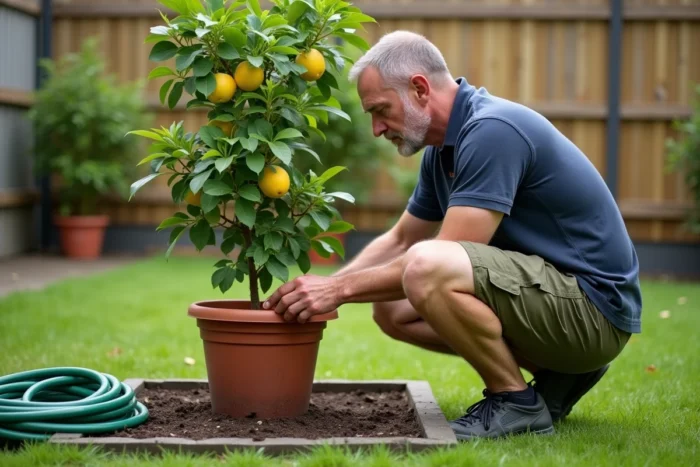
Yellow leaves, fruit drop, and curling foliage are common symptoms of both lack and excess of water. Without checking the substrate, visual diagnosis alone often leads to worsening the problem.
Some indicators help differentiate the two situations:
- A lack of water causes leaves to curl inward, dry at the edges, and fall while remaining green or slightly yellowed. The substrate is dry at depth
- An excess of water leads to a general yellowing that starts with the lower leaves, often accompanied by a persistent smell of damp soil. The leaves fall off soft, not dry
- The drop of small fruits (aborted fruit set) in early summer often indicates a sudden water stress, in either direction, at the time of flowering or just after
On the other hand, a lemon tree that loses a few old leaves in summer without massive yellowing is simply reacting to the natural renewal of its foliage. This phenomenon does not justify changing the watering.
Hard water and potted lemon trees: an underestimated factor
The lemon tree prefers a slightly acidic substrate. In regions where tap water is very hard, repeated waterings throughout the summer eventually alkalinize the potting soil. Iron then becomes less available to the plant, causing chlorosis: the leaves yellow between the veins, which remain green.
Collecting rainwater for summer watering of the lemon tree is the simplest solution. If not, letting tap water sit for 24 hours in an open watering can allows chlorine to evaporate, but does not change the lime content. A one-time application of chelated iron on the foliage corrects chlorosis without addressing the root cause, which remains the accumulation of lime in the substrate.
Regular repotting, every two to three years, with fresh substrate suitable for citrus fruits, remains the most effective way to start anew on a healthy basis and limit the imbalances accumulated over time due to watering.