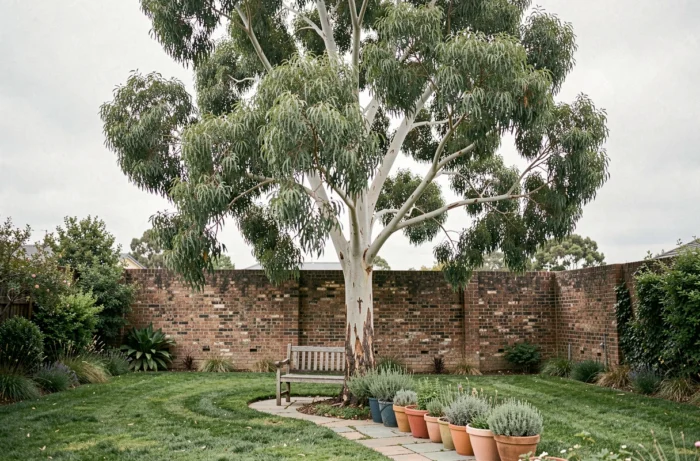
Does planting a eucalyptus or a tea tree at the back of the garden suffice to keep mosquitoes away from a terrace? A study published in 2024-2025 on lemon-scented ornamental plants grown in pots provides a measurable answer: no significant reduction in the number of mosquitoes captured around the plants compared to control areas, whether the leaves are intact or crushed.
The gap between the repeated promises on gardening blogs and the available scientific data deserves closer examination, species by species.
Repellent effectiveness of trees: what the data really shows
Competing articles list “anti-mosquito” trees without distinguishing between two very different mechanisms: the passive presence of a tree in a garden and the concentrated extraction of its essential oils applied to the skin or mechanically diffused.
| Tree or shrub | Main active molecule | Spatial repulsion (whole tree in the ground) | Repulsion by extracted essential oil |
|---|---|---|---|
| Lemon eucalyptus | Citronellal, PMD | Not demonstrated in real conditions | Documented, often short protection duration |
| Tea tree (Melaleuca) | Terpinen-4-ol | Not demonstrated in real conditions | Moderate effect in topical application |
| Neem tree | Azadirachtin | Not demonstrated in real conditions | Recognized insecticidal properties on crops |
| Osmanthus | Linalool | Not demonstrated in real conditions | Few specific studies on mosquitoes |
The conclusion is clear: whole trees do not provide measurable spatial repulsion in outdoor environments. Volatile compounds disperse too quickly in open air to maintain a deterrent concentration around a living area. Extracted essential oils that are then applied or diffused show documented repellent activity, although their complete protection duration often remains under twenty minutes for certain formulations.
Among the listed species, the anti-mosquito eucalyptus tree on Les Défricheurs features a detailed sheet that distinguishes the different varieties of eucalyptus and their active ingredient contents.

Lemon eucalyptus, neem tree, and tea tree: analysis of species differences
Not all so-called repellent species are equal. Their value depends on the local climate, mature size, and especially the concentration of active molecules in the foliage.
Lemon eucalyptus (Corymbia citriodora)
The citronellal found in its leaves forms the basis of PMD (para-menthane-3,8-diol), the only plant-based repellent recognized by several health agencies for topical application. The tree grows quickly, reaches a significant height, and adapts to well-drained soils in southern France. Crushing its leaves releases a marked lemon scent, but this diffusion remains localized to a few centimeters from the hand.
Neem tree (Azadirachta indica)
Its insecticidal properties have been utilized for decades in tropical agriculture. Azadirachtin disrupts the developmental cycle of many insects. However, the neem tree requires a warm climate and does not tolerate prolonged frost, limiting its cultivation to certain Mediterranean areas in mainland France.
Tea tree (Melaleuca alternifolia)
Its cultivation in the ground remains marginal in France due to its sensitivity to cold. Tea tree essential oil acts more as an antiseptic than as a spatial repellent. Its value against mosquitoes focuses on soothing bites rather than prevention.
In contrast, osmanthus, often cited in anti-mosquito lists, has very few specific studies on its repellent effect against culicids. Its pleasant scent (linalool) may mask body odors, but no solid data confirms real effectiveness.
Planting strategy in the garden: combining trees with truly effective actions
Planting a lemon eucalyptus or a neem tree offers real landscaping and aromatic interest. Relying on these trees as the sole mosquito barrier would be a mistake.
- Eliminating stagnant water remains the most effective action: saucers, clogged gutters, uncovered rainwater collectors are the main breeding sites for mosquitoes, including the tiger mosquito now present in most French departments.
- Regularly crushing the leaves of aromatic trees (eucalyptus, Madagascar lemongrass if grown in pots) temporarily releases volatile compounds, without guaranteeing lasting protection across a terrace.
- Active diffusers based on metofluthrin or transfluthrin have shown, in the cited study, a clear reduction in mosquito captures around treated areas, where whole plants failed.
- Combining low plants (lavender, peppermint, basil) at the foot of the trees increases the olfactory diversity of the garden without significantly altering mosquito pressure, but enriches the biotope for pollinators.
Anti-mosquito trees and the French climate: which species to plant according to your region
The choice of a tree depends as much on hardiness as on repellent promise. A neem tree planted in Brittany will not survive the first winter. A lemon eucalyptus in Provence will find favorable conditions, but its rapid growth requires sufficient space and regular pruning.
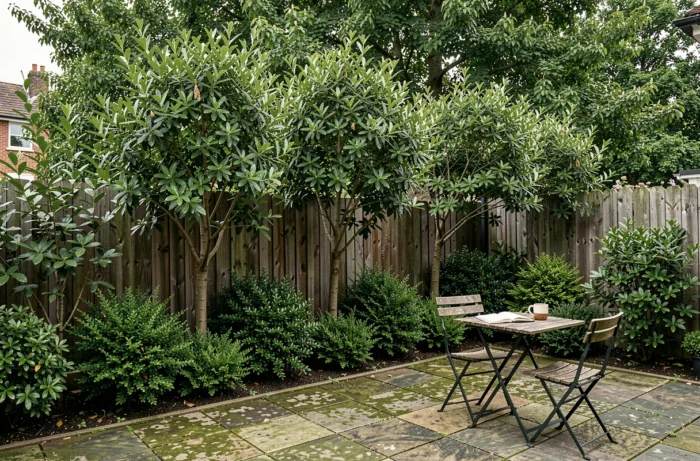
For gardens located north of the Loire, options are limited. Osmanthus (hardy down to about -15 °C depending on varieties) and some cold-resistant cultivars of Melaleuca are alternatives, with the already mentioned reservation about their unproven repellent effectiveness.
The best compromise remains a tree suited to the soil and local climate, whose aromatic foliage provides olfactory pleasure, combined with rigorous anti-larval measures. Betting on a single “miracle” tree to protect a terrace is more about horticultural marketing than vector control.
Recent scientific data all point in the same direction: no tree planted in the ground replaces the elimination of larval breeding sites. The lemon eucalyptus and neem tree deserve their place in a garden for their ornamental and aromatic qualities. Their role as a mosquito shield, however, remains to be proven under real conditions.