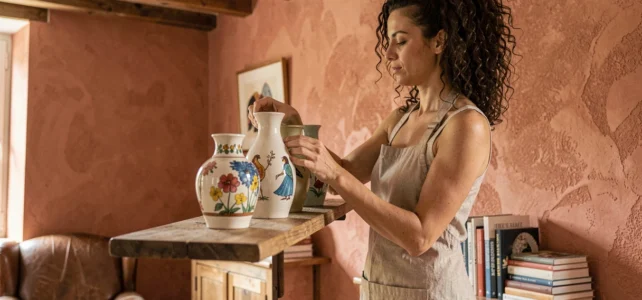
A white wall, a gray sofa, a standard shelf: many interiors look alike without their inhabitants having truly chosen them. Personalized decoration starts from a simple principle. Every object, every color, every texture in a room can tell something personal. Transforming an interior doesn’t necessarily require a huge budget, but rather a clear intention behind each choice.
Emotional decoration: choosing objects that trigger a reaction
Have you ever noticed that an object brought back from a trip makes you smile every time you catch sight of it? It’s not a coincidence. Recent studies in environmental psychology show that personal objects enhance the feeling of attachment to home and reduce daily stress.
This approach has a name in Anglo-Saxon decor media: dopamine decor. The principle is not to follow a predefined style (Scandinavian, industrial, bohemian), but to fill the space with elements that consciously evoke joy, nostalgia, or calm in the inhabitant, even if the mix seems eclectic.
In practical terms, this can take the form of a collection of ceramics gathered over the years, a fabric brought back from a market, or an enlarged photo on an unexpected medium. The idea is to start from emotion, not from a catalog. To explore various customization options (prints, decorative objects, custom creations), platforms like imaginairdeco.fr offer options that specifically serve this type of approach.
Personalized wall art: going beyond the simple photo frame
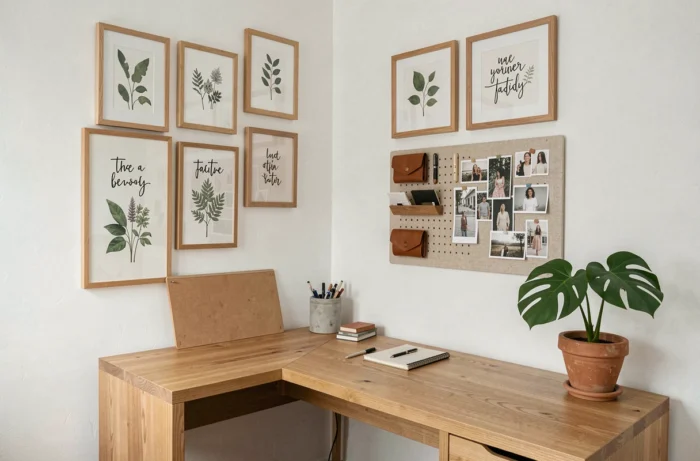
The gallery wall is everywhere on Pinterest, and for good reason: it’s one of the most accessible ways to personalize a space. But most compositions are limited to aligning identical frames with standard prints.
To go further, consider mixing formats and mediums on the same wall. A photo printed on wood next to a framed illustration, a small vintage mirror slipped between two canvases, an old botanical board near a child’s drawing: it’s the contrast that creates personality.
Some ideas to vary wall supports
- A photo on wood gives a matte and warm finish, very different from a classic paper print under glass
- Typographic posters with a date or a word that matters to you add a narrative layer without visually overwhelming
- A framed textile (vintage scarf, piece of wax fabric, embroidery) brings texture where the wall is flat
The trap to avoid: buying ten items at once to “fill” the wall. Personalized wall art is built over time. Each piece added must have a reason for being there.
Colors and materials: composing an atmosphere that reflects you
Many people choose their wall colors last, almost by default. An off-white “to play it safe.” The problem is that a room without chromatic intention lacks character, regardless of the furniture.
Color personalization begins with a question: what feeling do you want to experience in this room? Calm in the bedroom, energy in the office, friendliness in the living room. The answer guides the choice much better than a Pantone trend.
The underestimated role of natural materials
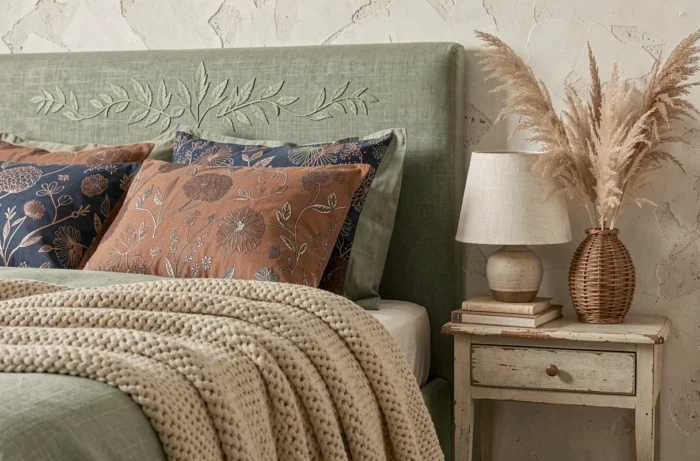
Raw wood, crumpled linen, terracotta, rattan: these materials bring a sensory dimension that smooth and uniform surfaces cannot offer. Combining two or three natural materials in the same room creates depth without adding extra color.
For example, an olive wood tray placed on a black metal console, with a stoneware vase next to it, is enough to create a corner that draws the eye. Texture does as much work as color in successful personalized decoration.
Custom furniture and repurposing everyday objects
Custom furniture is not just for big budgets. A simple shelf designed to the exact dimensions of a nook, an entry bench tailored to the width of the hallway: these adjustments give the impression that the home was designed for you, not the other way around.
The current trend goes even further. Custom furniture increasingly incorporates storage solutions adapted to remote work. A foldable desk in a closet, a niche dedicated to cables and chargers: personalization is rooted in daily uses, not just in aesthetics.
Repurpose rather than buy new
Before ordering a new decorative object, look at what you already own. An old wooden crate that is sanded and polished becomes a bedside table. A painter’s ladder transforms into a plant shelf. A set of glass jars serves as vases for dried flowers.
- A vintage suitcase stacked on a trunk creates a characterful side table
- Wallpaper scraps glued inside a bookshelf transform a basic piece into a unique item
- An old window frame hung on the wall becomes an original support for attaching photos with clips
This type of repurposing costs little, but it tells a story. And that’s exactly what distinguishes a decorated interior from a lived-in one.
Personalized decoration has no one-size-fits-all formula. It relies on an accumulation of deliberate choices, big or small, that ultimately form a coherent whole because they all come from the same place: what matters to you. An interior where every object has its reason for being doesn’t need to be perfect to be successful.