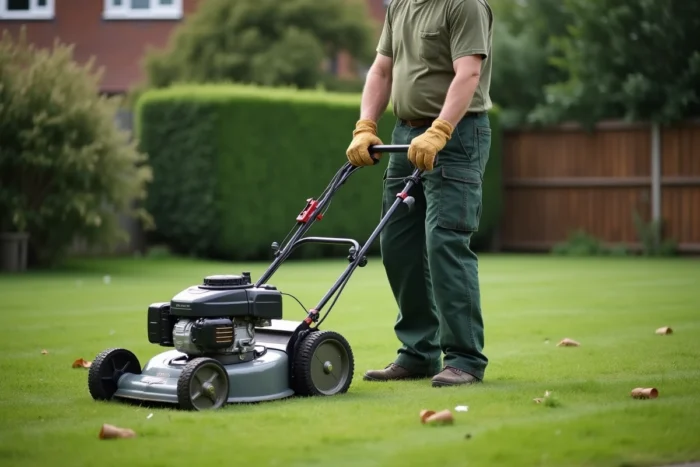
A plot of 2,500 m² represents an area where the choice of mower is no longer limited to the type of engine. The configuration of the ground, the presence of slopes, trees, or narrow areas weigh as heavily as the power of the engine in the final decision. Recent comparisons confirm this trend: traction, cutting width, and adaptation to the terrain now take precedence over engine displacement in the selection criteria.
Before detailing the technical parameters, one must pose a question that few buyers articulate clearly: do you really need a push mower, or does the terrain already justify a basic ride-on mower, or even a zoned robotic mower?
Uneven or sloped terrain: self-propelled, ride-on, or robotic mower
On a flat and open area of 2,500 m², a self-propelled gas mower with a sufficient cutting width does the job without difficulty. The problem arises as soon as the terrain presents slopes, obstacles to navigate around, or narrow passage areas.
Self-propulsion becomes almost essential as soon as there is a slope, even a moderate one. The drive wheels significantly reduce physical effort and prevent premature fatigue for the user on a surface of this size. Most field reports converge on this point.
The entry-level ride-on mower is an alternative for very open areas, but it shows its limits on cluttered plots. Its larger cutting width reduces mowing time; however, its bulk makes navigating obstacles cumbersome. To find out which gas mower for 2500 m2 is suitable for uneven terrain, the answer often leans towards self-propelled rather than ride-on.
The zoned robotic mower is gaining ground in discussions. It divides the plot into autonomous sectors and works without human intervention. Field reports vary on this point: some users report difficulties on steep slopes and transitions between zones, while others appreciate the time savings. The acquisition cost remains significantly higher than that of a conventional gas mower.
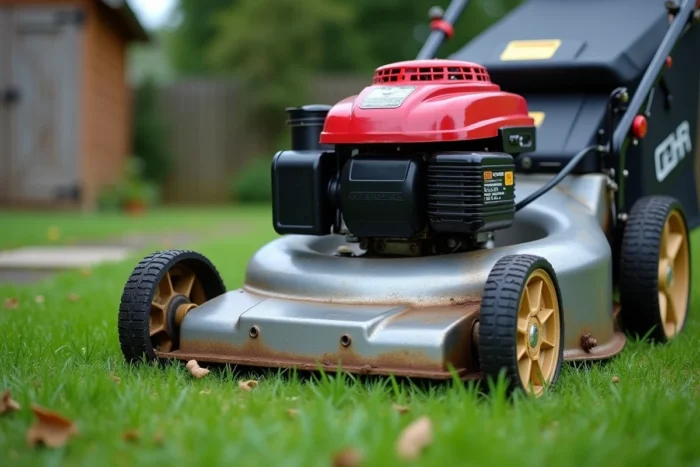
Cutting width and forward speed on 2,500 m² of lawn
The cutting width directly determines the number of passes needed to cover the entire area. On 2,500 m², a cutting width that is too narrow significantly prolongs mowing. Models designed for this area generally feature blades suitable for large gardens.
Conversely, a very wide blade requires a more powerful engine to maintain a correct rotation speed. The compromise lies between acceptable mowing time and maneuverability in narrow areas or along edges.
Adjustable forward speed changes the game
Recent self-propelled mowers offer variable forward speed. This adjustment allows for speeding up on open areas and slowing down in tricky passages. On a 2,500 m² plot with varied configurations, this feature truly alters the comfort of use.
Usability comfort weighs as heavily as engine displacement in the final choice. A large-capacity grass collector reduces trips to empty it. A steel or aluminum deck withstands stone projections better than a plastic deck, especially on a terrain that is not perfectly cleaned.
Self-propelled gas mower: the technical criteria that really matter
Comparisons highlight engine displacement as the main criterion, but it only tells part of the story. Here are the parameters that truly differentiate models on a plot of this size:
- The type of wheels and their diameter: large-diameter rear wheels facilitate passage over uneven terrain and improve traction on slopes
- The mulching function, which finely shreds the grass and redeposits it on the lawn, eliminates the need for collection and nourishes the grass, but requires more frequent mowing to be effective
- The starting system: a classic pull-start requires physical effort, while an electric start simplifies the process, especially for regular use
- The quality of wheel bearings, rarely mentioned in product sheets, but which determines the smoothness of movement over several seasons
The engine displacement remains an indicator of raw power. An undersized engine will struggle in tall or wet grass. An engine suited for 2,500 m² must be able to maintain its speed without overheating throughout the mowing duration, which can exceed an hour depending on the configuration.
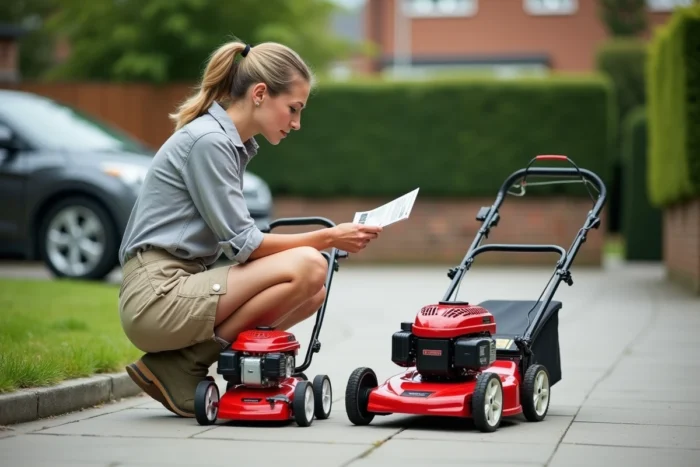
Maintenance of a gas mower: what the 2,500 m² area implies
Mowing regularly on a plot of this size puts more strain on the engine than a small garden mowed once a week. The air filter clogs faster, the engine oil degrades more quickly, and the blade dulls after fewer sessions.
The frequency of maintenance increases proportionally to the mowed area. Sharpening or replacing the blade at least once per season maintains a clean cut and reduces the effort required from the engine. Neglecting this point results in tearing the grass rather than a clean cut, which weakens the lawn.
Fuel storage and noise
Storing gasoline requires precautions, especially between seasons. Fuel that stagnates for several months in the tank can clog the carburetor. Emptying the tank at the end of the season or using a fuel stabilizer prevents this problem.
Noise remains the acknowledged weak point of the gas mower. During a mowing session that lasts over an hour, auditory fatigue adds to physical fatigue. Local regulations often limit mowing hours, a factor to consider in organizing garden maintenance.
The choice between self-propelled, ride-on, and robotic mowers is not just a budget question. The shape of the terrain, tolerance for noise, and desired mowing frequency guide the decision as much as the technical characteristics. On 2,500 m² with relief, a well-equipped self-propelled mower covers most needs without the investment of a ride-on, provided one accepts the mowing time and mechanical maintenance that come with it.