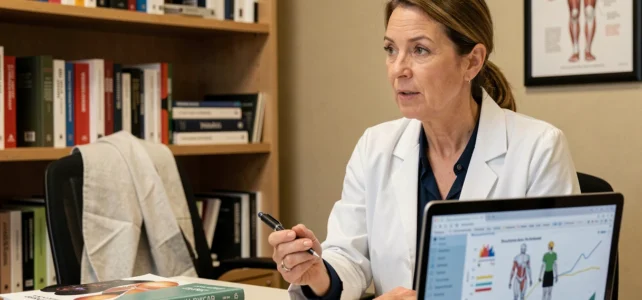
Distinguishing reliable information from unfounded claims in health requires a method. Between advice shared on social media, family recommendations passed down through generations, and content generated by artificial intelligences, health professionals, in France and elsewhere, face patients who come to consultations armed with beliefs that sometimes contradict available scientific data.
Health Misinformation: What Field Reports Reveal in Pharmacies
The first link confronted with medical misconceptions is not always the doctor. Pharmacists, accessible without an appointment, receive daily requests based on false information. A recent professional survey shows that health misinformation directly complicates care in pharmacies, with concrete consequences for treatment adherence.
The most common situations involve the refusal of certain medications based on rumors, substitution with unvalidated products, or questioning of prevention protocols. The phenomenon is no longer limited to vaccines. It now affects antibiotics, chronic treatments, and even common medical devices.
This field observation aligns with analyses published by Skeptic North’s health articles, which have documented for several years the persistence of unfounded medical beliefs in French-speaking and English-speaking countries. The problem is not specific to any particular healthcare system.

Conversational AI and Health Research: A New Vector for Misconceptions
The arrival of conversational AIs in medical information search profoundly changes the public’s relationship with health data. Unlike a traditional search engine that provides a list of sources, a chatbot delivers a single answer, formulated confidently, without always indicating its limitations.
Several analyses point out that generative AIs can produce inaccurate medical responses with an assertive tone. The lack of nuance in the formulation gives the reader the impression of an established truth, while the response may rely on outdated or misinterpreted data.
The Concrete Limits of Generated Responses
A chatbot does not distinguish a solid scientific consensus from a preliminary hypothesis. It does not weigh the quality of the studies it synthesizes. For a patient seeking to understand a diagnosis or assess a risk related to a treatment, this lack of evidence hierarchy poses a real problem.
Some health professionals believe that AIs can usefully direct users to reliable resources, while others observe a rise in erroneous self-diagnoses. The available data do not yet allow for precise measurement of the impact of these tools on preventive behaviors.
European Regulatory Framework: Health as a Specific Misinformation Risk
Medical misinformation is no longer treated as a simple public education issue. A report from the French Senate now identifies health misinformation as a distinct risk category in the wake of the European Digital Services Act (DSA).
This report recommends several structural measures:
- A grading of misinformation risks, placing health among particularly sensitive areas, alongside public safety
- Extending the obligations currently imposed on very large digital platforms regarding the fight against misleading content to generative AI platforms
- Strengthening reporting and moderation mechanisms for unverified health content or content contradicting health authority recommendations
This regulatory aspect reflects a political awareness. Health misconceptions are no longer just a matter of family folklore or individual ignorance. They circulate on an industrial scale, amplified by recommendation algorithms that favor polarizing content.
Prevention and Scientific Data: Topics Where Beliefs Persist the Most
Some medical misconceptions persist despite decades of research and public communication. The fields of cancer prevention, obesity, and physical activity concentrate a significant share of beliefs resistant to scientific data.
Overestimated Risks, Ignored Risks
The public tends to overestimate certain media-highlighted risk factors (food additives, electromagnetic waves) while underestimating well-documented risks (prolonged sedentary behavior, regular alcohol consumption even at moderate levels). The perception of health risks does not correspond to their scientific hierarchy, and this distortion directly fuels misconceptions.
In France, surveys conducted on the quality of health information show that trust in health professionals remains high, but coexists with massive consultation of unverified sources on the web. This dual usage creates contradictions that patients do not always resolve in favor of medical advice.

The Role of Misunderstood Statistics
A poor reading of medical statistics generates as many false beliefs as deliberate misinformation. Confusing correlation with causation, interpreting relative risk as absolute risk, or generalizing the results of a preliminary study to an entire population are common errors, even in the media.
Professionals themselves must master statistical and epidemiological tools to better decipher scientific articles. If caregivers sometimes struggle to assess the robustness of a study, expecting the general public to do so spontaneously is an illusion.
Verifying Medical Information: Effective Reflexes
Decoding a health misconception does not require advanced scientific training, but a few systematic reflexes:
- Identify the primary source of the claim: a study published in a peer-reviewed journal carries more weight than an isolated testimony or a blog article without references
- Check the publication date: medical recommendations evolve, and a valid data point from ten years ago may be obsolete today
- Cross-check with the positions of national health authorities (Inserm, HAS, sante.fr) that provide dedicated analysis spaces for health misinformation
- Beware of absolute formulations (“cures,” “proven 100%,” “miracle”) that almost always signal unreliable information
The fight against medical misconceptions relies less on denouncing false beliefs than on the ability to trace back to sources. Verifying health information rarely takes more than a few minutes when one knows where to look. The real obstacle remains the reflex to settle for a quick answer, especially when it confirms what one already thought.